

Robots are increasingly being asked to operate in environments that are complex, changing, and difficult to fully predict in advance.
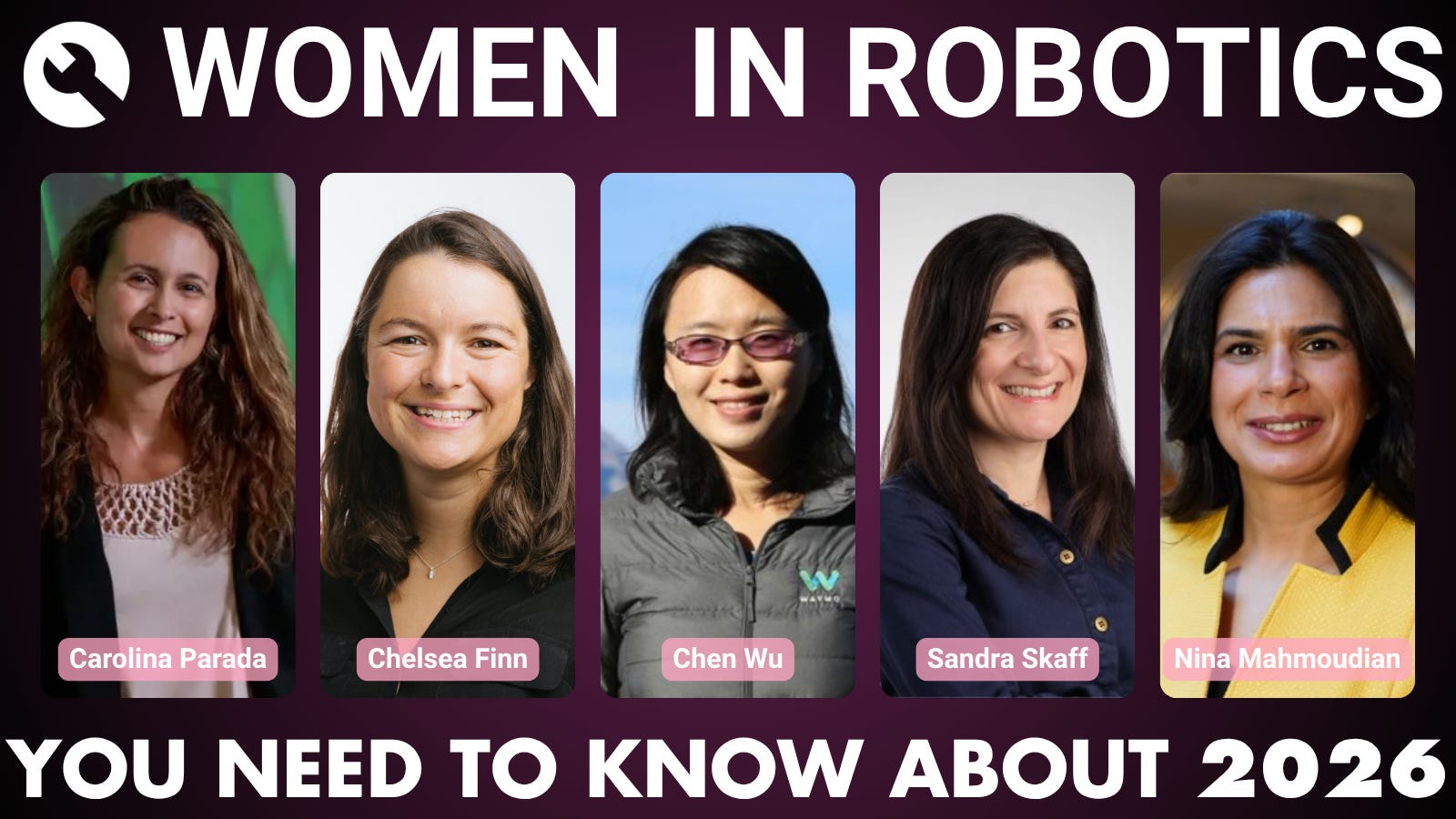
This week, we’re highlighting five women from the 2026 Women in Robotics You Need to Know About list whose work spans robot learning, perception, autonomous systems, and the broader robotics ecosystem.
Carolina Parada
Carolina Parada is vice president and head of robotics at Google DeepMind, where she leads the team behind Gemini Robotics. Her work focuses on giving robots more general intelligence so they can understand what is happening around them, adapt when conditions change, and handle a wider range of physical tasks.
In 2026, Google DeepMind introduced Gemini Robotics 2, showing robots using the same underlying AI to perform dexterous manipulation, control their whole bodies, and coordinate with one another. Parada has spent her career working at the intersection of AI and robotics, and today she is helping shape how advances in large AI models move beyond computers and into machines that act in the physical world.
Chelsea Finn
Chelsea Finn is an assistant professor of computer science and electrical engineering at Stanford University and a co-founder of Physical Intelligence. Her research asks how robots can acquire broadly useful behavior through learning and interaction rather than relying on narrowly programmed skills.
Finn has made influential contributions to robot learning, visual manipulation, reinforcement learning, and meta-learning, including methods that help machines adapt quickly to new tasks from limited experience. At Physical Intelligence, she is helping push robotics toward general-purpose models that can work across different tasks, robots, and environments. Her research has been recognized with the ACM Doctoral Dissertation Award and the Presidential Early Career Award for Scientists and Engineers.
Chen Wu
Chen Wu is Senior Director, Head of Perception at Waymo, where she leads engineers and researchers building the real-time perception systems that power the Waymo Driver. Her teams develop machine-learning methods that allow autonomous vehicles to interpret complex environments using cameras, lidar, radar, and external audio receivers.
Wu has spent more than a decade at Waymo helping move advanced perception research into deployed autonomous-driving systems. That work requires identifying road users and objects, reasoning about difficult and unusual situations, and delivering reliable performance at real-world scale. She holds a PhD and MS in electrical engineering from Stanford University and a BS from Tsinghua University.
Sandra Skaff
Sandra Skaff leads robotics ecosystem development at NVIDIA, where she works with startups, researchers, and industry partners building new robotic systems. Her work connects those teams with the computing, simulation, and AI tools they need to develop and test robots.
Skaff started her career in computer vision and spent years in research and development before moving into broader roles at NVIDIA. She previously led the company’s global academic research engagements and has worked across both startups and larger technology companies. She holds a PhD and master’s degree from McGill University, has authored or co-authored 20 peer-reviewed papers, and has been granted 13 patents. Today, she focuses on helping robotics teams move new ideas from research into practical systems.
Nina Mahmoudian
Nina Mahmoudian is a professor of mechanical engineering at Purdue University whose research focuses on autonomous systems that can operate persistently in difficult and changing environments. Her lab develops low-cost robotic platforms and control methods for ground, surface, and underwater missions.
Mahmoudian’s work includes autonomous underwater vehicles, long-duration mission planning, underwater docking, energy-aware operation, and coordination among multiple robots. Her group has also developed low-cost underwater gliders and navigation methods for infrastructure inspection and marine research. By combining controls, planning, and energy management, she works to make autonomous robots more capable of completing extended missions with less human support and lower operating cost.