

Getting a robot to perform a task once is very different from making it work reliably when objects, environments, people, and operating conditions change.
This week’s five honorees are working across manipulation, industrial automation, field deployment, and robot learning—areas where robotics has to move from technical possibility to practical use.
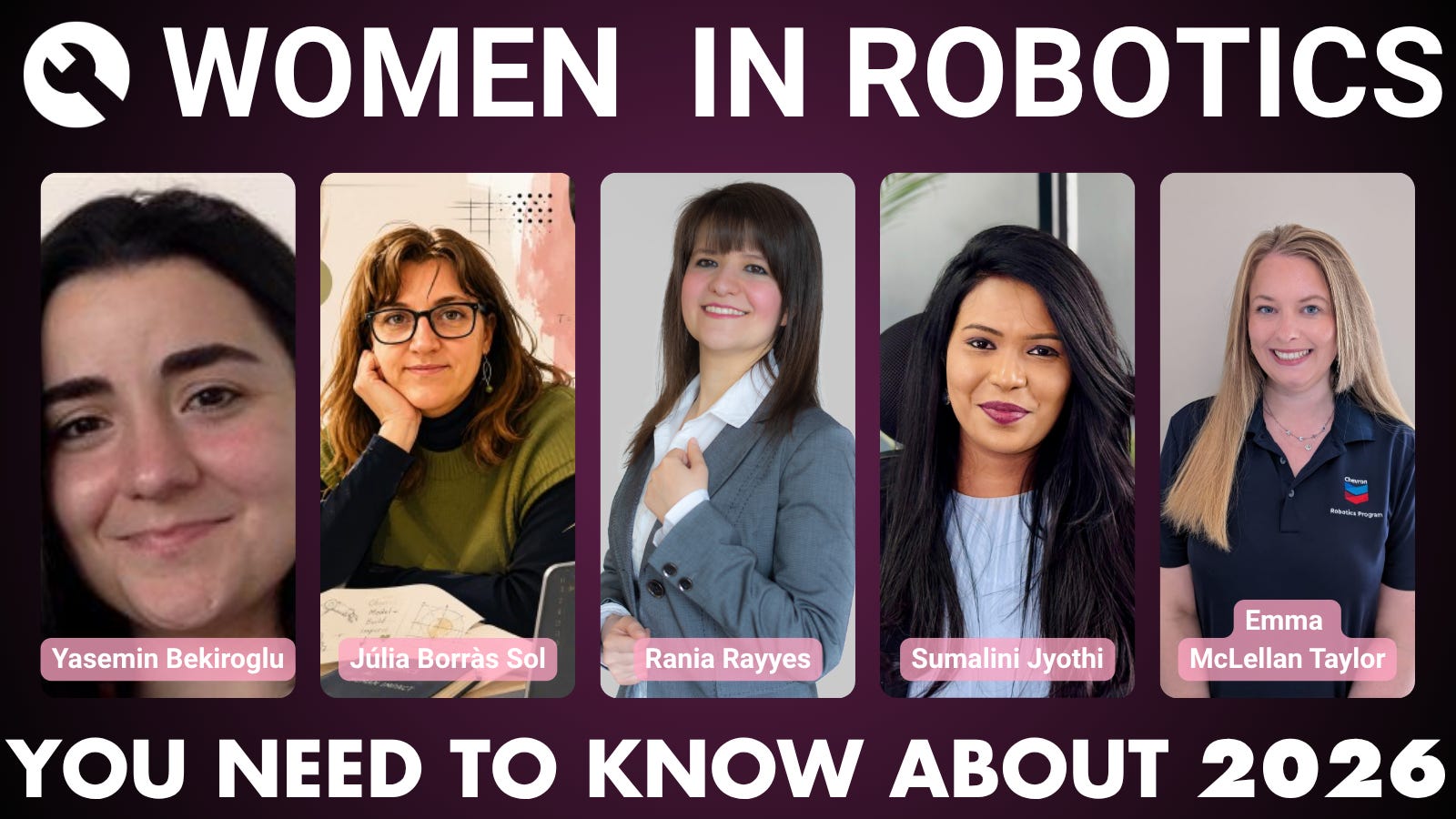
Yasemin Bekiroglu
Yasemin Bekiroglu is an associate professor in Systems and Control at Chalmers University of Technology. Her research centers on robot learning and manipulation, with an emphasis on enabling robots to learn efficiently from multimodal sensory data such as vision, touch, force, and proprioception.
Her 2026–2031 research program targets autonomous mobile manipulation in unstructured environments, combining perception, planning, and control so robots can adapt to new objects and contact-rich tasks with less training data. Bekiroglu has also worked in industrial and academic robotics at ABB, University College London, and other organizations, and received the ICRA Best Manipulation Paper Award in 2013.
Júlia Borràs Sol
Júlia Borràs Sol is a research scientist and vice-director at the Institut de Robòtica i Informàtica Industrial in Barcelona, where she works in perception and manipulation. Her research tackles one of robotics’ persistent challenges: reliably handling deformable objects such as cloth and other soft materials.
Borràs leads projects including FlexCycle, which develops flexible robotic solutions for recycling soft materials, and CHLOE-Map, focused on representing and manipulating cloth-like objects. She also leads work on personalized robotic assistance and safe manipulation for healthcare and food-handling applications. Before returning to IRI, she spent seven years conducting research at Yale University and Karlsruhe Institute of Technology. Since 2023 she is Senior Editor of the IEEE Robotics and Automation Letters journal.
Rania Rayyes
Rania Rayyes is a junior professor at Karlsruhe Institute of Technology, leading the AI and Robotics research group. Her research focuses on uncertainty-aware and interactive robotics: enabling robots to adapt autonomously to changing tasks in sustainable and circular manufacturing, and to learn from and interact intuitively with humans in dynamic, human-centered environments.
Rayyes develops AI methods designed to operate on real-world industrial robotics rather than only in simulation. Her work spans adaptive manipulation, sim-to-real transfer, lifelong learning, intuitive human-robot learning, and explainable robot behavior. Her research contributions have been recognized with several awards, including the IEEE RAS Outstanding Women in Robotics and Automation Early Career Contribution Award, and the Robotics Talent Award for her Ph.D. dissertation from the Lower Saxony Ministry of Digitalisation in Germany.
Sumalini Jyothi
Sumalini Jyothi is co-founder and CEO of ASHWAA Engineering, a Hyderabad-based industrial automation and robotics company founded in 2020. She leads the company’s effort to build technically rigorous, cost-effective automation systems for manufacturers.
ASHWAA designs and deploys automation across automotive, aerospace and defence, medical devices, food and FMCG, warehouse and logistics, and general manufacturing. The company reports delivering more than 300 projects across six sectors. Jyothi’s background spans aerospace engineering, quality, project management, and business, giving her a multidisciplinary approach to building and scaling industrial automation in India.
Emma McLellan Taylor
Emma McLellan Taylor works at Chevron, where she leads practical deployment of robotics and AI in the energy industry. Her work sits at the transition point between technical capability and field adoption: identifying where robotic systems can create value, integrating them into existing operations, and helping teams turn emerging technology into usable tools.
A chartered engineer, McLellan Taylor brings an engineering perspective to robotics in an industry where remote, difficult, and potentially hazardous environments create strong opportunities for automation. She is also active in STEM outreach, including hands-on robotics clubs for young students.