

Robots designed to interact directly with people bring a particular set of challenges. They may need to navigate the human body, respond safely to physical contact, communicate through touch, or understand the people around them.
This week, we’re highlighting five honorees whose work spans medical robotics, human-robot interaction, compliant systems, prosthetics, grasping, and haptics.
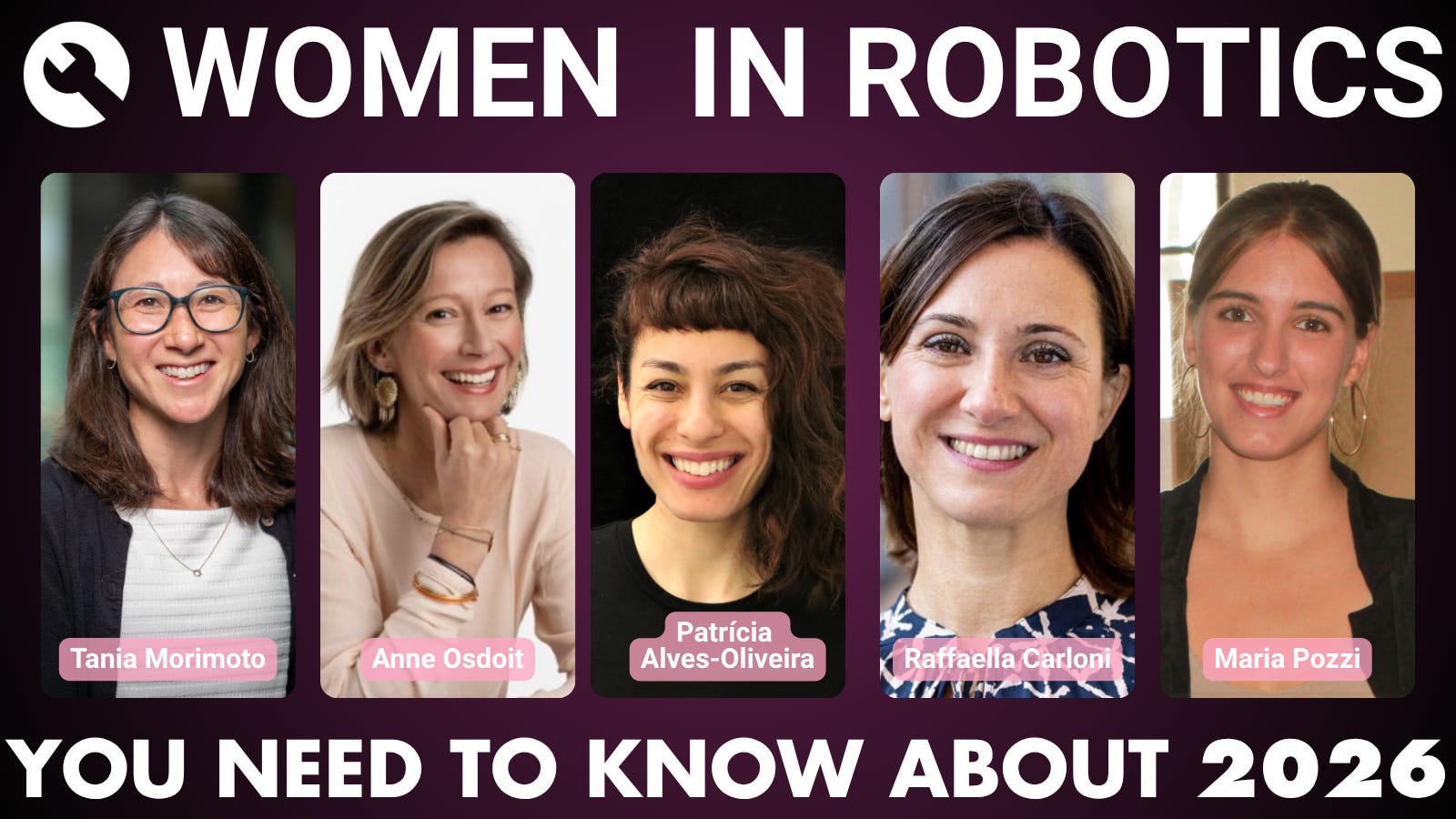
Tania Morimoto
Tania Morimoto is an associate professor of mechanical and aerospace engineering and surgery at the University of California, San Diego, where she develops soft and flexible robots for minimally invasive medical procedures. Her work focuses on creating robotic systems that can move safely through delicate, confined parts of the body and adapt to the uncertainties of real clinical environments.
In 2026, Morimoto began leading an ARPA-H project to develop a soft “growing robot” that can travel through blood vessels and perform procedures such as removing clots during an ischemic stroke. Her broader research includes continuum surgical robots, teleoperation, and haptic interfaces, all aimed at giving surgeons more precise and adaptable tools for treating patients.
Anne Osdoit
Anne Osdoit is the founding CEO of Moon Surgical, where she has helped take the company’s Maestro surgical robot from an early-stage concept to use in operating rooms. Maestro is designed to assist surgeons during minimally invasive procedures while allowing them to remain at the bedside and work with familiar laparoscopic techniques.
Osdoit has spent much of her career building and supporting medical technology companies, with experience spanning product development, clinical strategy, investment, and commercialization. Alongside her role at Moon Surgical, she is a partner with Sofinnova Partners’ MD Start strategy. Her work sits at the intersection of robotics and medicine, with a focus on making robotic assistance more practical and accessible in everyday surgical care.
Patricia Alves-Oliveira
Patricia Alves-Oliveira is an Assistant Professor of Robotics at the University of Michigan, where she leads Robot Studio. Her research focuses on embodied social intelligence: designing robots that understand human needs, work naturally with people, and can be evaluated with real users outside controlled laboratory settings.
Her group develops human-centered robotic systems for health, combining robot design, AI, and human-robot interaction. Before joining Michigan, Alves-Oliveira was a Senior UX Designer at Amazon Lab126, contributing to the Astro home robot; she also serves on Meta’s Advisory Board on Critical Issues for AI. Her work has been recognized with a DARPA Young Faculty Award, the 2025 ICRA Human-Robot Interaction Award, and multiple awards at the International Conference on Human-Robot Interaction. Alves-Oliveira's research has been supported by NSF (US), SNSF (Switzerland), and the Ministry of Land, Infrastructure, Transport and Tourism (Japan).
Raffaella Carloni
Raffaella Carloni is professor of robotics at the University of Groningen, where she chairs the Human-Centered Robotics group in the Bernoulli Institute. Her research focuses on the design, modeling, and control of compliant robotic systems that can interact safely and effectively with people.
Carloni’s work spans soft and novel actuators, human-centered robot design, and prosthetic devices, connecting fundamental robotics research with assistive technologies. She previously held faculty positions at the University of Twente and earned her doctorate in robotics from the University of Bologna. Her research helps advance robots that are physically adaptable rather than rigidly separated from human users.
Maria Pozzi
Maria Pozzi is an assistant professor (RTD-A) at the University of Siena (Italy) whose research focuses on robotic grasping and manipulation, soft robotic hands, wearable haptics, and human-robot collaboration. Her work examines how robots can handle objects robustly while communicating and coordinating more naturally with human partners.
Her research contributions span compliant and underactuated robotic hands, tactile interaction, collaborative manipulation, and human-robot augmentation, including supernumerary robotic systems that assist individuals with upper-limb impairments in manipulation tasks. She holds a PhD in Information Engineering and Science, carried out between the University of Siena and the Italian Institute of Technology (IIT) in Genoa. She has also been selected as an RSS Pioneer and serves in editorial roles for major robotics publications and conferences.